

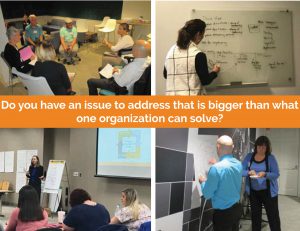
Is your organization facing a community issue it cannot address alone? Are you seeking to create collective impact by strengthening the talent pipeline, growing the population, developing the workforce, expanding childcare, addressing food deserts, reducing homelessness, or solving other social challenges?
In recent years, nonprofit organizations, donors, funders, and community leaders have developed new collaborations to address these challenges. Many now use a collective impact framework to tackle significant issues.
Collective impact brings together partners from business, government, philanthropy, and nonprofits to pursue a shared agenda and address specific social problems. While collaboration is common in the social sector, collective impact provides a more rigorous and comprehensive approach.
Five conditions together lead to meaningful results from collective impact. We introduced this framework several years ago on this blog and continue to use it to support coalition development.
Five Conditions of Collective Impact
- Common Agenda: All participants share a vision for change and a clear understanding of the problem. They have established a joint approach with agreed actions to address it.
- Shared Measurement: Establish a baseline and agree on key indicators. Collect and measure data consistently across all participants to ensure alignment and accountability.
- Mutually Reinforcing Activities: Participants lead activities aligned with their strengths and coordinate through a shared plan. The focus is on alignment and cohesion, not isolated efforts.
- Continuous Communication: Consistent, open communication builds trust, aligns objectives, and tracks progress. This keeps the coalition connected, motivated, and focused on results.
- Backbone Organization: Effective collective impact requires a dedicated organization with skilled staff to coordinate all groups. This backbone ensures progress, collaboration, and resource management.
Here is an example of collective impact in action. Consider the significant challenge of limited high-quality child care in a community, an issue we have addressed in several locations. (Learn here about coalition building)
Expanding a preschool classroom may increase child care supply for some families, but this isolated approach often does not address broader issues like access, availability, and affordability.
A collective impact approach unites partners who are directly or indirectly affected by limited child care:
- Child care influences a company’s ability to recruit and retain employees.
- Government-supported child care helps communities attract businesses, increases tax revenue, and supports the development of productive citizens.
- K-12 Education: Child care supports school readiness and long-term student success.
- Health: Child care promotes healthy development and helps children reach key milestones.
- Child Care Providers: Access to quality child care supports business sustainability and growth.
- Higher Education: The sector supplies the skilled workforce needed for quality child care.
Additional partners are joining these efforts.
After partners are engaged, the next step is to assess the issue and its impact on the community. This shared understanding shapes a common agenda supported by all partners. As a result, the community benefits from increased high-quality child care, extended hours to meet employer needs, scholarships to improve affordability, and wraparound supports that connect families and providers to essential resources. The coalition monitors agreed-upon metrics, such as the number of spots by age group, certified teachers, cost of care, and uptake rate. A communication plan ensures information is shared within the coalition, as well as with the public and stakeholders. This approach enables the community to make significant progress in addressing child care shortages.
Our Approach to Collective Impact
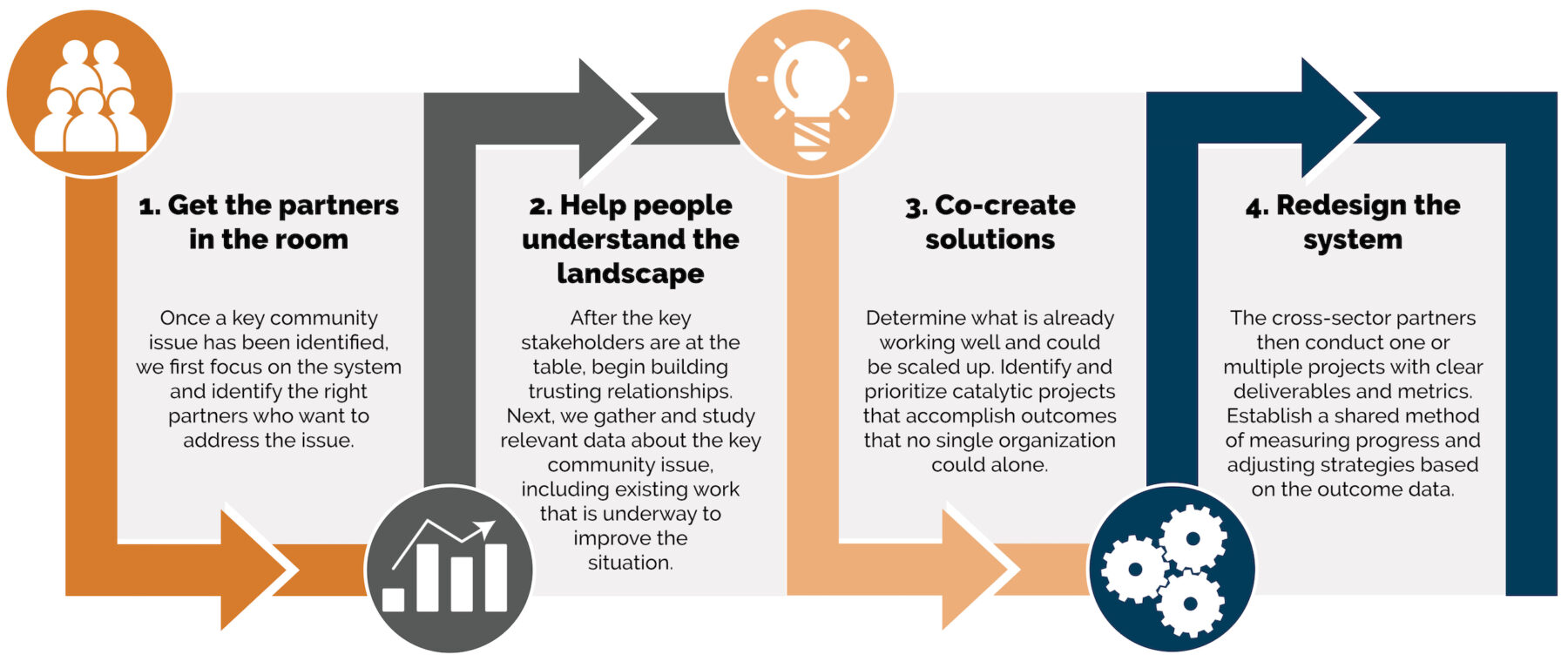
- Facilitate understanding of the landscape by first bringing key stakeholders together and building trust. Then, gather and analyze relevant data on the community issue, including current improvement efforts.
- Co-create solutions by identifying what is working well and can be expanded. Prioritize projects that achieve outcomes beyond the capacity of any single organization.
- Redesign the system by having cross-sector partners implement projects with clear objectives.