

What should every unique audience, compelling story, and powerful metrics have in common with your annual report? The answer should be a no-brainer: your mission. In this blog, we’ll put the spotlight on the reason why we’re all here – weaving your organization’s mission through every element of your annual report, making it the best branding, marketing, fundraising, and storytelling tool you have.
Let’s get into it.
Element 3: Weave the Mission Throughout
The Mistake: Featuring your mission statement prominently in the introduction and never mentioning or alluding to it again as the report expands into separate sections.
The Solution: Create thematic consistency by sewing every section of the report together with the thread of your organization’s mission, core purpose, and strategic goals.
Implementation Strategies
- Mission as Organizing Principle: Structure the report around your organization’s mission pillars or values instead of departmental sections. If your mission focuses on education, mental health, and economic sustainability, organize content into those three sections and provide context with the services or staff that deliver the work.
- Consistent Language Threading: Identify the 3-5 key messages of your organization and/or strategic plan and incorporate them throughout the written content. This repetition reinforces your focus and helps readers understand your “why.”
- Goal Progress Reporting: If your organization previously shared strategic goals or major campaigns for the year, dedicate ample space to report on their progress. Be transparent – show both achievements and areas still requiring work. Stakeholders appreciate honesty about ongoing challenges, and may even be compelled to step in to help.
- Visual Mission Reinforcement: Use design elements such as branded color coding, icons, or section headings to help readers visually recall your mission components. This creates a subconscious kind of recognition, even for audiences that simply glance.
Example Structure
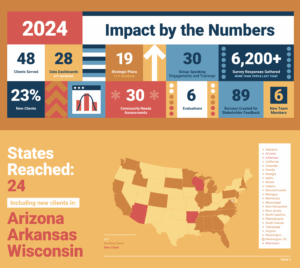
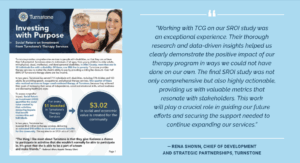
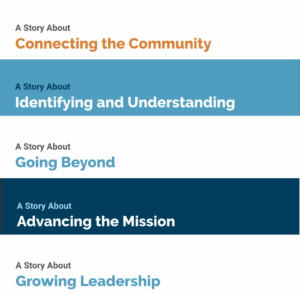
Case Study
Transform Consulting Group’s own annual report clearly connects back to our mission to “helping each of our clients use data to fulfill their missions and achieve their desired outcomes, customizing and tailoring our solutions to their unique needs.” Our goal is for clients to do more with their data.
Read more about understanding your “why” here.
Up Next in the Series: Essential Element 4 of Annual Reports
Prioritizing Clean Design with Visual Storytelling
Now that you have the first 3 Essential Elements of Annual Reports: The Audience, The Story, and The Mission, you’re ready to start your graphic design journey. Learn to make a clean annual report design with visual storytelling in the next blog, Element 4 of Annual Reports: The Design.
Free and inexpensive graphic design tools are available almost everywhere you look these days. The best part about these tools is the suite of templates that come included. Guaranteed, there will be a template you can use for your annual report if contracting a professional designer isn’t in the cards for your organization.
Read Element 4 of Annual Reports: The Design now.
Additional Resources
Listen to the Full Episode
In Episode 25 of the W(h)ine About Data Podcast, our Communication Manager, Morgan Ellis, sits down with our President, Amanda Lopez, to discuss practical strategies for creating annual reports that stakeholders actually want to read and share with their networks. Whether you’re producing your first annual report or refining an established process, this guide breaks down the 5 essential elements every nonprofit annual report needs.
Listen to the full conversation, or continue reading the blog series for key takeaways and actionable tips you can implement immediately.
Related Blog Posts
- Annual Report Challenges: Why Nonprofits Struggle
- Element 1 of Annual Reports: The Audience
- Element 2 of Annual Reports: The Story
- Element 4 of Annual Reports: The Design
- Element 5 of Annual Reports: The Distribution
- 4 Strategies for an Effective Annual Report
- Subscribe to our monthly newsletter
- Link to services